Indonesia: palm oil, nickel, coal and tin in numbers
Indonesia is the world’s largest producer of palm oil, palm kernel oil, cloves and mined nickel, and a top-three or top-two producer of coal and tin. Few countries lead this many commodity categories at once, and fewer still lead them in such different families: a tropical tree crop, a battery metal, a fossil fuel and a solder metal. In 2024 coal was Indonesia’s single largest tracked export at $34.5 billion, with palm oil second at $21.1 billion (CEPII BACI). This article sets out what the data shows about each of the four, where Indonesia sits in world rankings, and how exposed its export base is to a handful of commodities.
Four commodities, four different rankings
Indonesia’s position is not the same in every market. It mines 66.7% of the world’s nickel and holds 47.6% of known reserves, by far its strongest position of the four (USGS Mineral Commodity Summaries, 2025). Palm oil is almost as dominant: 59.2% of world production in 2023 (FAOSTAT) and 48.2% of world export value in 2024 (CEPII BACI). Coal is a smaller share of world production than nickel or palm oil, but still substantial: 8.7% of world output in 2025 (Energy Institute) and 19.3% of world export value in 2024, making Indonesia the world’s second-largest coal exporter by value (more on that below). Tin is the odd one out: Indonesia mines 21.0% of world tin, ranking second, but sells 25.7% of world tin exports by value, ranking first. Mining a fifth of world tin while selling a quarter of its export value hints that Indonesia processes more of its own ore into exportable metal than some rivals, though the trade data alone cannot say why.
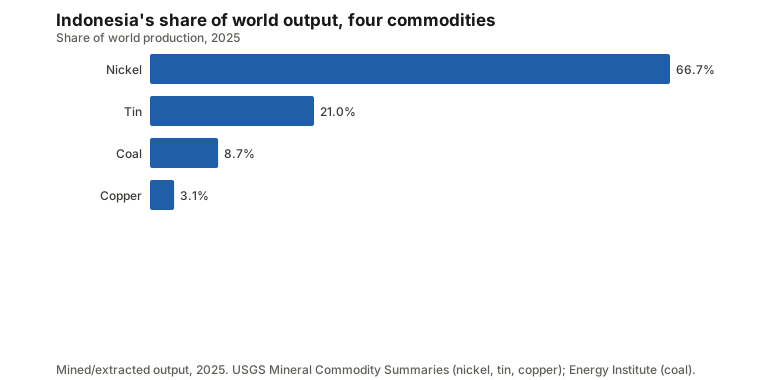
Indonesia also ranks in the top three producers of 17 of the 110 commodities with production figures on this site, and is the outright largest producer of four: cloves, nickel, palm kernel oil and palm oil. The country page lists the full set.
Palm oil: the anchor crop
Palm oil is Indonesia’s largest agricultural export by a wide margin. The country grew 47.1 million tonnes of it in 2023, 59.2% of world output, and its palm kernel oil output the same year was 59.4% of the world total (FAOSTAT). On the trade side, Indonesia sold $21.1 billion of palm oil and its fractions in 2024, 48.2% of world export value, a net export of $21.1 billion (CEPII BACI).
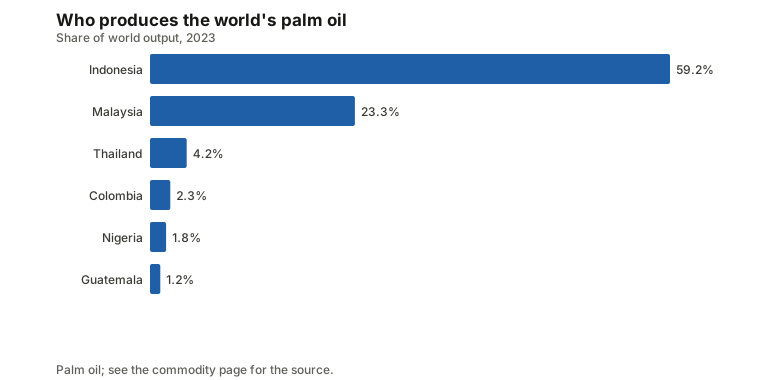
Malaysia is the only other producer of comparable scale, at 23.3% of world output. Together the two supply more than four-fifths of the world’s palm oil, which is one reason palm oil and other vegetable oil prices tend to move together; the vegetable oil prices guide explains the substitution between them. Palm oil’s rapid expansion in Indonesia has been widely reported as a driver of deforestation in Sumatra and Kalimantan, an association this site’s production and trade figures cannot themselves quantify, so that claim should be read as general reporting rather than as a number from this data.
Nickel: from ore to battery metal
Nickel is Indonesia’s most dominant commodity by production share. The country mined 2.6 million tonnes in 2025, 66.7% of the world total, and holds 47.6% of the world’s known reserves (USGS Mineral Commodity Summaries). At 2025’s output rate, those reserves would last about 33 years if neither figure changed, a mechanical ratio rather than a forecast.
Indonesia has restricted exports of unprocessed nickel ore since 2020, a policy widely reported as designed to push miners into building smelters at home rather than shipping raw ore abroad. The trade data is consistent with that story, even if it cannot confirm the mechanism: nickel is Indonesia’s largest mined commodity by far, yet its nickel exports were worth only $953.8 million in 2024, ranking Indonesia just sixth among world nickel exporters by value and well behind coal, palm oil, natural gas, copper and natural rubber among its own top export earners (CEPII BACI). Most of the value Indonesia adds to its nickel is evidently counted elsewhere, not on the raw-ore trade line this site tracks.
ABC News went inside Indonesia’s nickel industry to look at that boom and its costs:
Coal: still the biggest export line
Coal is Indonesia’s largest single tracked export. In 2025 it mined 790 million tonnes, 8.7% of world output and the third-largest national total (Energy Institute). In 2024 it sold $34.5 billion abroad, 19.3% of world export value, ranking Indonesia second among world coal exporters and making coal its largest net export at $30.9 billion (CEPII BACI). That single line exceeds palm oil and copper’s net exports combined, a reminder that despite Indonesia’s prominence in nickel for the energy transition, its biggest earner by value is still a fossil fuel.
Tin: a smaller metal, a large export share
Tin gets less attention than nickel or palm oil, but Indonesia’s position in it is just as concentrated. The country mined 61,000 tonnes in 2025, 21.0% of world output, ranking Indonesia second among world tin producers, and holds 23.3% of known reserves, which would last about 19.6 years at the current rate of extraction (USGS Mineral Commodity Summaries). On the export side Indonesia is the world’s largest tin seller, $1.65 billion in 2024, 25.7% of world export value and a net export of $1.62 billion (CEPII BACI). Tin is used mainly as solder in electronics, a smaller market than nickel or coal, but Indonesia’s share of it is no less dominant.
How dependent is Indonesia on a few exports?
This site tracks 36 of Indonesia’s exported commodities, worth $90.0 billion combined in 2024. A single commodity, coal, accounted for 38.3% of that tracked total, with palm oil second at $21.1 billion, or 23.4% of it (CEPII BACI). That 38.3% figure is a share of the 117 commodities this site follows worldwide, not Indonesia’s true total exports, which also include manufactured goods, oil products and services outside this dataset; read it as a measure of concentration within tracked commodities, not overall trade dependency. Even with that caveat, the ranking is informative: coal, palm oil, natural gas, copper and natural rubber are Indonesia’s five largest tracked exports, together making up the bulk of the $89.9 billion. The export dependency report ranks every country on this measure, and the concentration report and concentration over time report track how commodity concentration compares and changes across the world, including whether Indonesia’s own palm oil or nickel dominance is rising or falling.
Not every crop is growing
Indonesia’s headline commodities are expanding, but its land-and-yield data show that is not true everywhere. Natural rubber, Indonesia’s second-largest agricultural export by tracked value ($3.17 billion in 2024, 18.8% of world export value, and a $3.02 billion net export), has gone the other way: Indonesian output fell 22.1% over the ten years to the latest data, with harvested area down 7.4% and yield down 15.9%, so the decline came mostly from falling yield, not from farmers pulling up trees (FAOSTAT, three-year averages). Palm oil itself does not appear in this site’s land-versus-yield dataset for Indonesia, which only covers crops whose world output moved by at least 10% with area reported for most of it, so no equivalent split is available here; the land or yield report has the full set it does cover, and the producing, exporting and processing guide explains why production and export rankings, as with Indonesia’s tin and nickel, can tell different stories.
The short version
- Indonesia is the world’s largest producer of nickel (66.7% of output, 2025), palm oil (59.2%, 2023), palm kernel oil (59.4%, 2023) and cloves (74.4%, 2024).
- It is the second-largest miner of tin (21.0%) but the largest tin exporter by value (25.7%), and mines 8.7% of the world’s coal, its third-largest national total.
- Coal was Indonesia’s largest single tracked export in 2024 at $34.5 billion, ahead of palm oil at $21.1 billion.
- Coal alone made up 38.3% of the $90.0 billion in commodities this site tracks for Indonesia’s exports, a measure of concentration within tracked goods, not of total trade.
- Nickel is Indonesia’s dominant mined commodity, but its nickel exports rank only sixth in the world by value ($953.8 million), consistent with more of it being processed at home before sale.
- Not every Indonesian commodity is growing: tracked natural rubber output fell 22.1% over the past ten years, driven mainly by lower yield.
Figures are the latest available in each source and are not updated in real time. Nothing here is investment advice.
Commodities in this post
Prices are monthly benchmark averages that lag the market; informational only, not investment advice.